
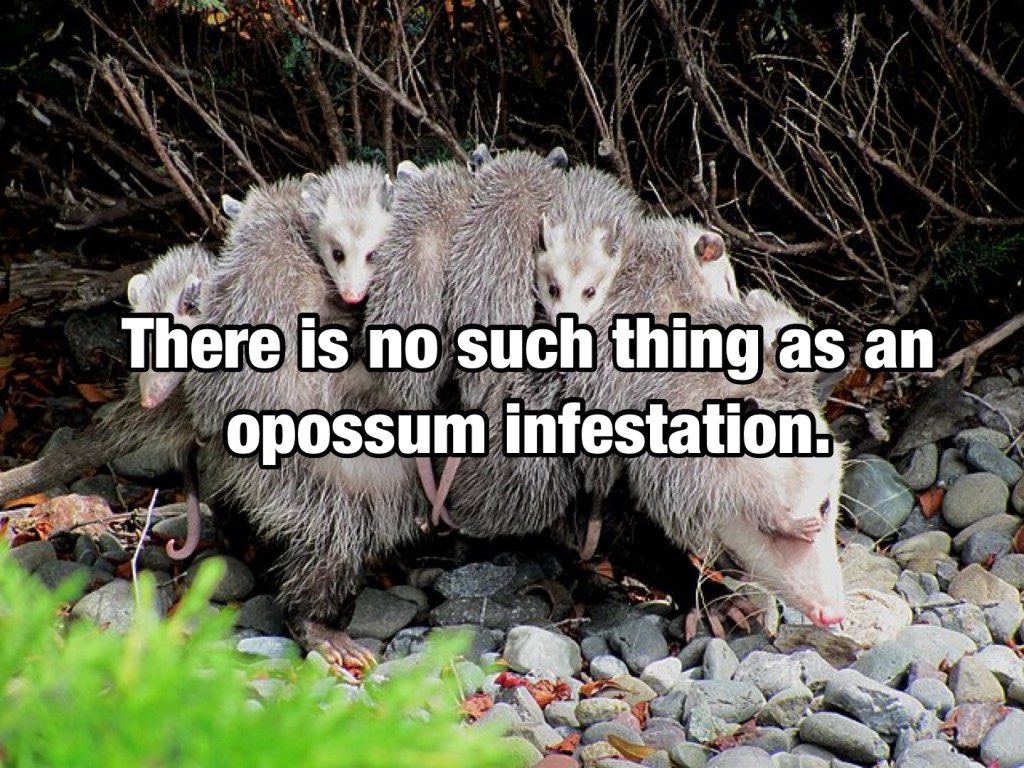
Opossum “infestations” are some of the most common reasons that these wonderful little animals end up killed. We’ve gotten many calls about opossums who had supposedly infested attics and crawlspaces, and we’ve heard many tragic stories of people managing these “infestations” with lethal measures.
The truth is, though, that opossum infestations simply don’t exist. Unlike cockroaches, rats, mice, and occasionally squirrels, opossums can’t and don’t move into human structures and breed prolifically there. It simply isn’t within their nature or their ability.
Virginia opossums are nomadic creatures. They do not have established territories. They don’t make dens or burrows or nests to raise their young, because they carry their young in the pouch or on the mother’s back. An opossum won’t leave her young behind in your attic and then come back for them later. Once they have fallen off her back, they are on their own and will continue their own nomadic lives.
Opossums also don’t hibernate, so it is not possible that you have an opossum hibernating on your property. Virginia opossums have adapted fairly well to the temperate ecosystems of North America, but they are direct descendants of tropical species that have no ability to go dormant for the season. They don’t even enter the lighter form of hibernation— seasonal torpor— like raccoons. Although they might sneak into a warm space temporarily, they generally keep traveling all winter in search of food and safety.
Opossums are antisocial once they’re past infancy. They don’t move into spaces in communal groups or travel together. It is nearly impossible to have more than one adult opossum in your home at the same time.
So why do so many people think they have opossum infestations?
Well, for one thing, mistaken identity happens more often than you’d think. We’ve been sent many pictures of “opossum infestations” that turned out to be Norway rats.
Sometimes, a homeowner will find a single adult opossum who has crept inside for warmth or shelter, and has immediately jumped to the conclusion that there was an infestation. A single animal, of course, is just a single animal, not an infestation. It can simply be removed and released outdoors, and the entry points can be closed.
A couple of opossum “infestations” turned out to be joeys that happened to fall off a mother opossum’s back when she happened to be in someone’s home. In one case, a family had heard quite a bit of commotion from their dog late at night and found several joeys in their house the next day. We were able to ascertain that a mother opossum had entered through the family’s doggie door and that her babies had fallen off when she was either attacked or chased away by the dog. (Those joeys were too young to be independent and made it into rehabilitation.)
If you spot an opossum in your house, odds are very high that you can take it for exactly what it is: an opossum in your house. It will move along just fine once you have closed the entry points. There’s no need to worry about an infestation and no reason to harm the animal.
 For Fox Sake Wildlife Rescue