Venomous snakes aren’t bad or evil. Like all other animals, they have an important role to play in our ecosystem. Among other things, snakes help to control populations of rats and mice. This in turn helps reduce the incidence of diseases these rodents might carry.
Nevertheless, you probably don’t want venomous snakes living too close to your house. While fatal bites are extremely rare, they do happen occasionally. This is one of the many reasons that bobcats can be useful neighbors to have around!
Bobcats are some of nature’s most fearless predators, making them one of the few native creatures bold enough to kill and eat venomous snakes. And bobcats are even less likely than venomous snakes to harm humans. No human has ever died of a bobcat attack! Letting your bobcat neighbor stick around is one of many ways you can keep your family (and your neighborhood ecosystem) safe and healthy for all.
A lot of people have been reaching out to us about a widely reported study that, according to the headlines, proves that raccoons are domesticating themselves. Half-serious social media posts are hailing this as the greatest news ever for people who fantasize about having a pet raccoon.
The only thing that the study demonstrated is that raccoons in rural areas have slightly longer snouts than raccoons in urban areas. Seriously. That’s all that the study found. It did not find that raccoons are orchestrating a plan to become our pets or that they would be happier in your living room than in the forest.
The findings of the study are truly interesting, because they confirm that, like foxes and mice, raccoons’ skull shapes are slightly different based on their proximity to humans. Shorter snouts are one very, very small component of “domestication syndrome,” which is the controversial notion that domestication, by its very nature, involves animals developing more infant-like physical and behavioral traits.
The recent raccoon study gives some support for the hypothesis that mammals with baby-like faces and brains may fare better in urban settings than rural ones. It means that raccoons with these traits may be less afraid of scavenging garbage, and maybe slightly less likely to get exterminated than raccoons with pointier snouts.
It does NOT mean that raccoons are now domesticated animals, or that it is ever acceptable to try to tame or own them. Even the cutest raccoons with baby faces are still raccoons, and freedom is their birthright.
If you have ever asked us our rates of “success”— the number of animals we actually release to the wild— you probably recall getting a polite non-answer. It may look like a red flag for a rehabilitator to not publicize their numbers, but the reason we don’t share them isn’t because our numbers are low. It’s because our numbers are misleading.
Take, for example, this year. We have only had one animal— Dammit the beaver— die in our care in 2025. We have had just two that were humanely euthanized. That doesn’t mean we’re doing an exceptionally good job compared to rehabilitators that have lost or euthanized dozens. It just means we’re taking the easy cases.
I (Juniper, the director) had major surgery to essentially have my leg broken and rebuilt in February, and I’m slow on my feet and my schedule is full of physical therapy. I decided early on that it would be inhumane and irresponsible to take newborn baby animals this year, during their most fragile stage, because I can’t be fast enough on my feet to bottle-feed thirty newborns six times a day and still manage to take care of everyone else. I also chose to take only a very small number of animals needing intensive care, for the same reason.
In other words, the high rates of “success” are a reflection of taking more stable patients, not a reflection of the quality of care. In the years when we’ve admitted tons of starved orphan newborns, animals with catastrophic injuries like disembowelment, and animals that arrived actively infected with fatal illnesses, our rates of both euthanasia and death in care were quite high.
At a conference, an instructor representing one of the largest and best-staffed rehabilitation facilities in the country asked the audience about what their actual rates of successful release are. Numbers were all over the place. Rehabbers who took only healthy older orphans, not sick or injured animals, had release rates of 90% or higher. Most people hung their heads and quietly said a number around 60%. A suburb-based songbird rehabilitator— someone who, no doubt, took in countless birds fatally injured by cats— quietly admitted release rates of less than 20%. The person teaching the class revealed that, after analyzing over a decade of records, her large, world-class rehabilitation facility only released 31% of animals admitted to their care— a result of taking many of the most hopeless cases, while less skilled rehabilitators often took the easier ones.
The reason we’re sharing all of this is because it’s important for the public to look at quality of care, not numbers, when determining which rehabilitators to support, and to understand why you’re unlikely to get an honest answer when asking about release rates. It’s also a reminder that success can take many forms.
Releasing an animal back to the wild is the success we always want. But ending the suffering of a fatally injured fawn, doing the best possible job with a critically emaciated newborn bobcat, or placing a disabled animal in an accredited education facility? Those are all successes too, even when they’re the ones rehabilitators don’t like to openly acknowledge.
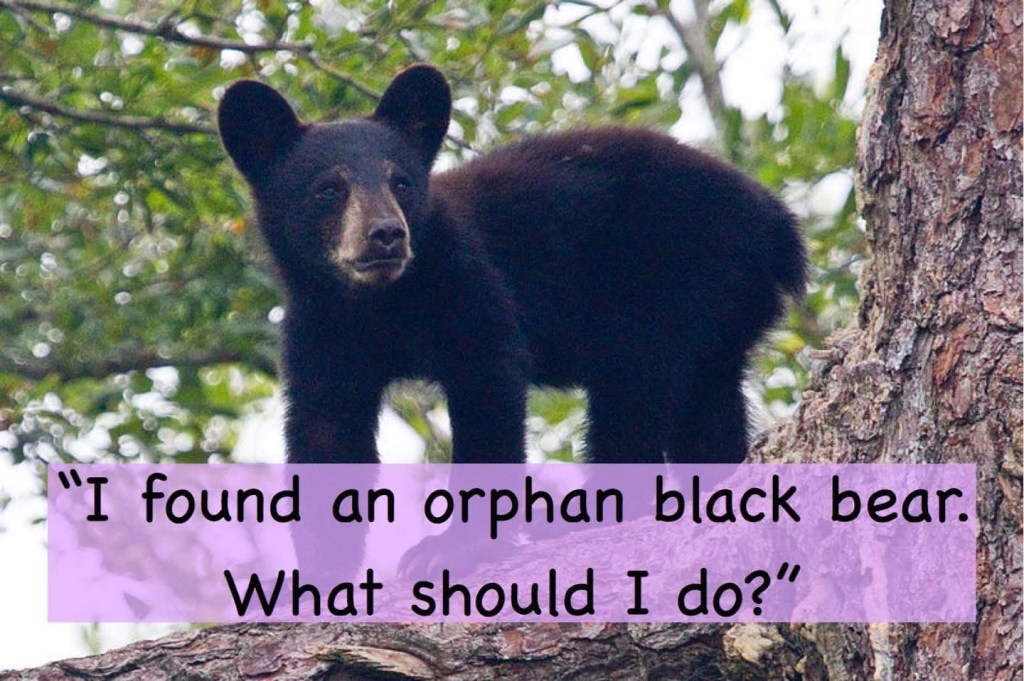
Black bears only rarely venture to the Chattanooga area, where For Fox Sake is located, but we occasionally get calls from people in other parts of the state, asking for help with orphaned black bears. They’re our favorite calls to take!
Should you end up confronting a bear cub in the wild, the most important thing to do is to watch for your own safety. Even a very thin or sickly-looking bear cub may still have a mother watching nearby. While black bears generally don’t pose a danger to humans, approaching cubs isn’t a risk you want to take. Watch from a distance, ideally with bear spray and a companion with you.
Cubs can be independent from Mom when they reach 30-35 lbs, about the size of a cocker spaniel. If you see a cub smaller than this and know is an orphan because you’ve seen the mother’s body with your own eyes, or because you’ve been watching it from a distance for more than 36 hours with no sign of Mom, it’s important to get the cub help.
Cases of unqualified people “helping” orphan bears with supplemental food can’t possibly end well. Not only is this “help” likely to fail to provide proper nutrition, but it will invariably lead to the cub associating humans with food— which we all know can’t end well. (Rehabilitators for black bears have special caging and equipment that allows them to feed bears without being seen.)
In Tennessee, the correct agency to contact about an orphaned bear is Tennessee Wildlife Resources Agency, specifically the game wardens local to your region and county. TWRA will often be able to send someone to help safely capture the cub. Do not attempt to capture the cub yourself.
Here in Tennessee, Appalachian Bear Rescue in Townsend is the only rehabilitation facility equipped to care for bears, so they will ultimately be the ones to rehabilitate any bears in need of assistance. If you do find a bear who ends up in need of help, consider making a donation to ABR so they can continue their work!
As black bears continue to reclaim their former range and as suburbs continue overtaking rural areas, encounters between humans and black bears will become more common. Let’s all work together to make sure to keep both humans and bears safe, especially when a cub needs help.
Are you one of the heroes who, despite feeling squeamish, checks for babies when you see a dead opossum? Awesome!
But you may not be sure what to do you find little pink jellybeans in the pouch. In the earliest weeks of development, opossums are hairless, translucent, and fused to the mother’s nipple. At that stage of development, we recommend simply leaving them alone so they can go to opossum heaven with their mommy.
Think of it this way: if a pregnant dog got hit by a car and killed, would you try to deliver her embryonic puppies? Marsupials like opossums use their pouch like a womb. At the stage when the embryos are still fused to the mother’s nipple, they are developmentally similar to early embryos of placental mammals. When removed from this “womb,” their chances of survival are near zero.
Trying to save them may cause more pain. If they are forcibly pulled from the mother’s nipple, they can suffer catastrophic injuries and may die. If the nipple is cut from the mother, the joey will slowly swallow and digest a rotting piece of flesh, something their bodies simply can’t do yet.
A few rescues have made claims that they can save babies this young and smaller, but we are skeptical. While older joeys can be tube-fed easily, feeding tubes small enough for the tiniest joeys simply don’t exist. Foster moms aren’t really a viable option at this stage, either: a joey can fuse to a nipple only once, when it is just minutes old, and won’t be able to reattach to a new mom. (Older joeys that have begun to detach from the nipple can do fine with foster moms, though.)
While we wish that each and every animal could be saved, the sad reality is that some opossums are simply too early in their development to be viable, and it is kindest to let them pass with their mother, without the stress and pain of being forcefully pulled from her body.
So where’s the line? Different rehabilitators have different policies, but we advise finders to remove joeys only if they detach from the nipple with a few gentle tugs. If you have to pull with force or cut the nipple, we believe that’s a sign that the babies are still just embryos and should be allowed to pass peacefully.
We were trying to take a very serious picture of Calliope to illustrate a very serious conversation. But it’s hard to get a very serious picture of an animal whose sole mission in life is to steal phones. 🤦
Anyway, let’s talk about the fact that people keep putting parts of dead animals on their faces. 🤮 Calliope would like to ask that you stop doing that.
You know mink eyelashes? Those really fluffy, ostentatious eyelash extensions that look breathtakingly gorgeous on 5% of people and absolutely ridiculous on the other 95%? Many people don’t even realize that those are generally sourced from real, abused mink.
When mink coats and mink stoles fell out of favor, the mink farm industry realized they could make a profit from eyelash extensions made from mink fur. The fur farms themselves are exactly the same as they have always been: these intelligent, curious, aquatic animals get jammed into little cages where they barely have space to move, and go their whole lives never being able to swim, play, or explore. At the end of these brutal lives, usually during their first winter, the mink are killed and their skin is ripped from their flesh.
Some of the sellers of mink lashes will deceive customers by claiming that fur is removed from the mink by “gently brushing” them, but anyone who has ever known a mink knows this is nonsense.
Calliope was handled and hand-reared from birth but is so fierce that she can’t even be touched. Do you really think that the stressed out, mass-produced mink raised in tiny wire cages are so friendly that they let people comb them? Come on. 🙄 Besides, even if you could brush a mink, you wouldn’t get much fur off them. They are very clean creatures that groom themselves constantly, leaving almost no loose fur that could be combed off.
So how do you avoid contributing to this cruelty? Well, I promise your eyelashes look great the way they are, but if you really want fake lashes, be sure to buy lashes labeled as vegan and cruelty-free. Even better, get the ones that are biodegradable!
You don’t have to kill an animal to look beautiful.
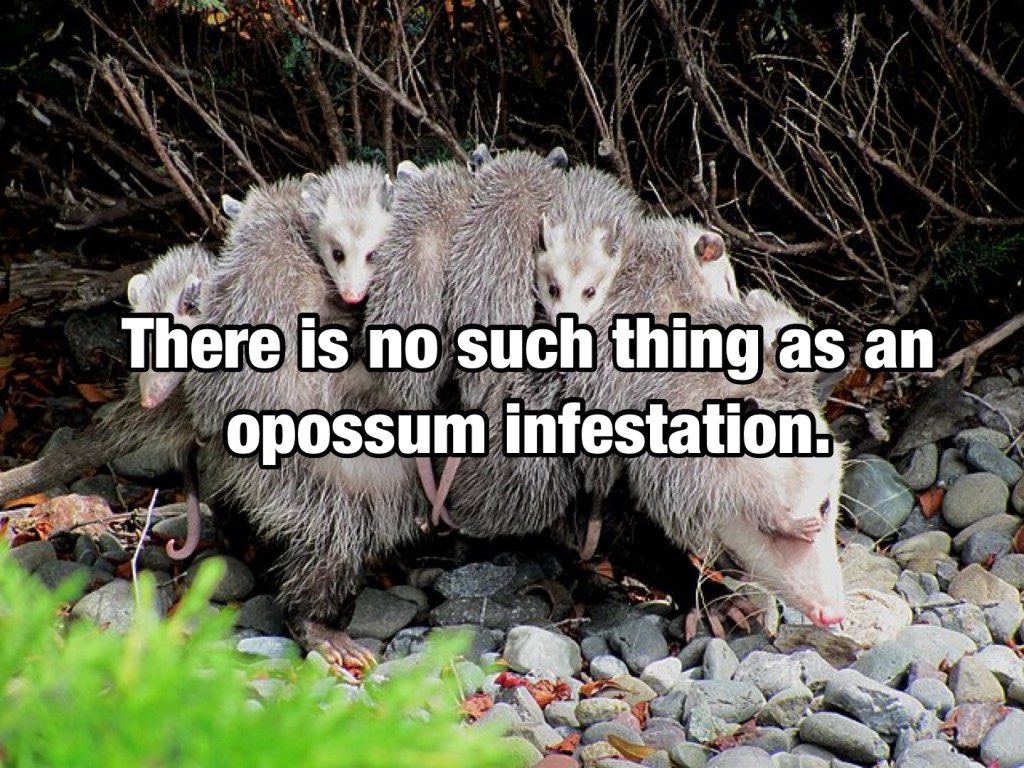
Opossum “infestations” are some of the most common reasons that these wonderful little animals end up killed. We’ve gotten many calls about opossums who had supposedly infested attics and crawlspaces, and we’ve heard many tragic stories of people managing these “infestations” with lethal measures.
The truth is, though, that opossum infestations simply don’t exist. Unlike cockroaches, rats, mice, and occasionally squirrels, opossums can’t and don’t move into human structures and breed prolifically there. It simply isn’t within their nature or their ability.
Virginia opossums are nomadic creatures. They do not have established territories. They don’t make dens or burrows or nests to raise their young, because they carry their young in the pouch or on the mother’s back. An opossum won’t leave her young behind in your attic and then come back for them later. Once they have fallen off her back, they are on their own and will continue their own nomadic lives.
Opossums also don’t hibernate, so it is not possible that you have an opossum hibernating on your property. Virginia opossums have adapted fairly well to the temperate ecosystems of North America, but they are direct descendants of tropical species that have no ability to go dormant for the season. They don’t even enter the lighter form of hibernation— seasonal torpor— like raccoons. Although they might sneak into a warm space temporarily, they generally keep traveling all winter in search of food and safety.
Opossums are antisocial once they’re past infancy. They don’t move into spaces in communal groups or travel together. It is nearly impossible to have more than one adult opossum in your home at the same time.
So why do so many people think they have opossum infestations?
Well, for one thing, mistaken identity happens more often than you’d think. We’ve been sent many pictures of “opossum infestations” that turned out to be Norway rats.
Sometimes, a homeowner will find a single adult opossum who has crept inside for warmth or shelter, and has immediately jumped to the conclusion that there was an infestation. A single animal, of course, is just a single animal, not an infestation. It can simply be removed and released outdoors, and the entry points can be closed.
A couple of opossum “infestations” turned out to be joeys that happened to fall off a mother opossum’s back when she happened to be in someone’s home. In one case, a family had heard quite a bit of commotion from their dog late at night and found several joeys in their house the next day. We were able to ascertain that a mother opossum had entered through the family’s doggie door and that her babies had fallen off when she was either attacked or chased away by the dog. (Those joeys were too young to be independent and made it into rehabilitation.)
If you spot an opossum in your house, odds are very high that you can take it for exactly what it is: an opossum in your house. It will move along just fine once you have closed the entry points. There’s no need to worry about an infestation and no reason to harm the animal.
One of the hardest parts of what we do is caring for the Glitter Animals.
“Glitter Animals” is a game, of sorts, that I started playing by myself when caring for animals who have any of the closely related and highly lethal carnivore parvoviruses: canine distemper, canine parvovirus, feline panleukopenia, and raccoon parvovirus, all of which can infect multiple species. I play this “game” to remind myself of how incredibly contagious these viruses are.
The animal, I tell myself, is covered in glitter. I imagine that it is everywhere, falling from their fur at all times. Their poop, vomit, blood, and spit are all glitter. They breathe glitter. They pee glitter. And if any trace of the glitter makes it to an unvaccinated animal of a susceptible species, it, too, will become a Glitter Animal.
The glitter is on my gloves as soon as I touch the animal, and when my gloves hand brushes against my pants, it’s on them too. If I set the animal in a blanket on my lap while I’m feeding it, the glitter falls onto my shoes and onto the floor when I pick the blanket up. And the blanket itself, of course, will need to be washed not just once, but two or three times to get all the glitter off. If I put an animal on a scale, the scale is now covered too, completely. An incubator that has housed a glitter animal needs an incredibly thorough cleaning.
Glitter Animals need food, fluids, and medicine many times throughout the day, day and night. When there are other animals who also need 24 hour attention here at this very small facility, there is almost nothing that can be done to completely stop the spread of the glitter.
Glitter Animals usually die even with the best treatment, and it’s illegal, here in Tennessee, to take some Glitter Animals. We only end up with them when an animal develops the disease while in our care. We quarantine new patients and vaccinate all animals over four weeks old, but occasionally, one of our animals still becomes a Glitter Animal.
Glitter Animals are an enormous challenge, and we often have to make very painful decisions: do we try to save the Glitter Animal even if it means we must severely limit our number of other patients? Would it be wrong to turn away five healthy fox kits— or risk exposing them to the “glitter”— because we are treating one raccoon for distemper and simply don’t have enough space or time to guarantee that glitter won’t make its way around?
These are hard decisions that rehabilitators and shelter workers make almost every day, and they’re hard ones. Our choices often come down to which animals have the best chance, our amount of available space, and any applicable state laws. It’s never easy, but we always do our best.
When someone calls us and describes an animal that has symptoms consistent with any of the “glitter” diseases— some of which also have symptoms similar to rabies— we often hear anger and frustration over the fact that we must turn these patients away. But please ask yourself: how many glitter animals could really be treated in one small facility?
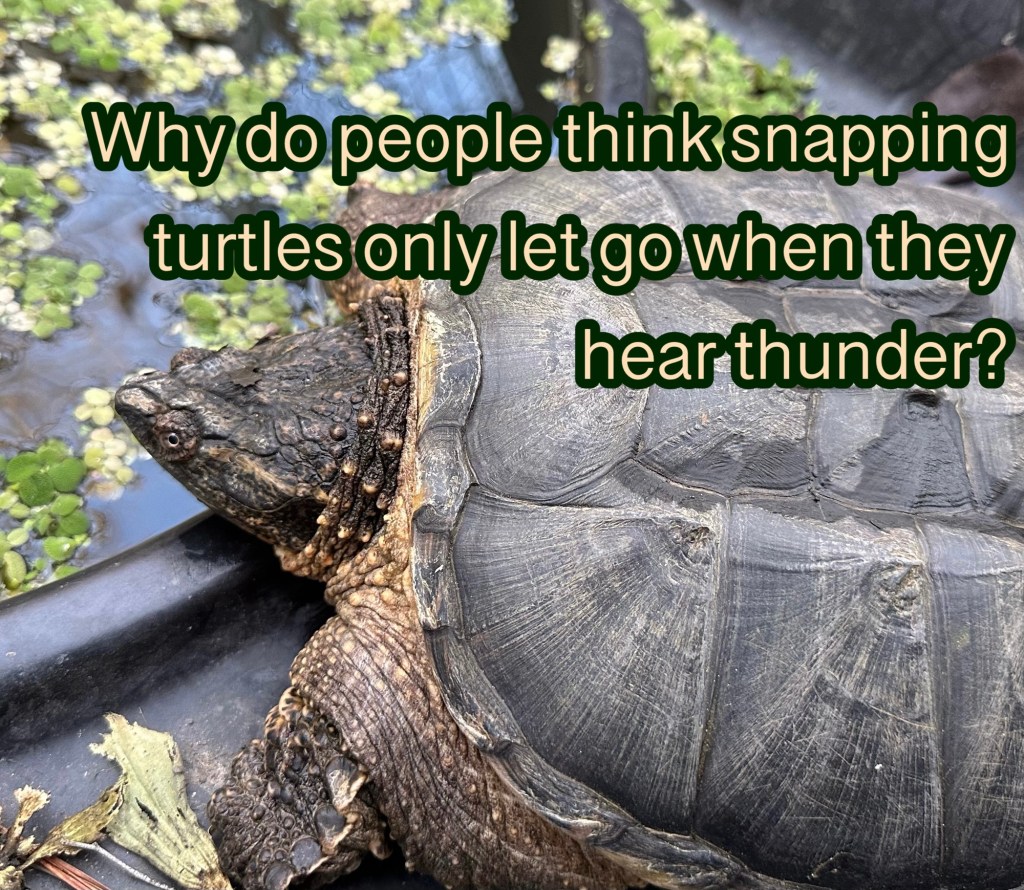
When I was about six years old, I found a snapping turtle walking across my grandmother’s yard and eagerly ran inside to tell her. In a panic, she ordered me to stay inside until it was gone, warning me that if a snapping turtle bites you, it won’t let go until it hears thunder.
I felt like I had narrowly escaped a horrible fate, that the turtle might have bitten me and then I’d be stuck carrying a massive turtle half my size on my ankle for weeks. I imagined sitting in first grade and having to explain to my teacher that I was stuck with the turtle until the next thunderstorm.
I also imagined that I would have liked the turtle anyway, and felt bad for him— being stuck on a person for weeks didn’t sound so great for the turtle, either!
Until Fossil joined our education program, I thought my grandmother was the only person who believed this bizarre myth, but I quickly learned that it’s very, very common, particularly in the Southeastern U.S. In some regions, they’re even called “thunder turtles,” rather than snapping turtles!
The internet as a whole doesn’t seem to have an explanation for this odd legend, but after looking into it, I have my own theories.
The Yoruba people of West Africa historically had a rich anthology of myths and folktales involving tortoises and turtles. Many stories about tortoises connect them to herbal medicine and fertility, while freshwater turtles are prominent in tales about weather and rain.
The Yoruba spirit Sango, who is still revered widely around the world, and is strongly associated with thunder, lightning, and rain. Traditionally, freshwater turtles were seen as friends of Sango, and were sometimes sacrificed in his honor.
While I can’t say for sure— and I’m neither a historian nor an expert in folklore— I have a hunch that, when Yoruba people were enslaved and forcibly brought to the American South, the association between turtles and thunder came, too… and that this influence spread to people of all backgrounds, fossilized into our collective cultural memory.
If this is where the myth comes from, it wouldn’t be the only way that African culture has shaped North America’s relationship with turtles. To this very day, the term “cooter” — which originated in the West African Mandinka and Bambara languages— is used by scientists and grandmas alike to refer to a group of freshwater turtles native to the Eastern U.S.
Snapping turtles definitely don’t hold onto anything they bite until they hear thunder, but it’s interesting to consider where these notions may have come from and all the ways that history shapes how we think about animals.
So what do you think? Have you heard this old wives’ tale, and if so, when and where? If you have your own theories and knowledge about why people associate snapping turtles with thunder, please let me know!
Leaving corn for deer and other wildlife may seem benign, or even beneficial, but it is actually one of the most harmful things you can do for neighborhood wildlife. We generally recommend against feeding wildlife at all, with the possible of migratory songbirds. But if you insist on feeding wildlife, please avoid corn at all cost!
Corn is junk food for wildlife. Most native wild animals are unable to efficiently digest corn. In the short term, it causes diarrhea and gas that can quickly turn fatal. In the long run, corn contains far too much sugar for most wildlife and an improper balance of vitamins, minerals, and macronutrients.
Opossums and squirrels that eat corn can develop metabolic bone disease, while waterfowl develop angelwing syndrome. Deer, especially in winter, can die of ketoacidosis when corn sharply increase in their blood sugar— especially in winter, when their bodies change to adapt to a very limited diet.
Corn also attracts the “wrong” animals. Non-native rats and mice tend to love corn and will unnaturally overpopulate an area where corn is fed. These species are harmful to wildlife, often destroying nests and eggs of native birds and out-competing our native rodents. When these overpopulated rodents spread, it may lead to your neighbors using rodenticides, which then kill the predators who eat poisoned rats.
Corn left outside, particularly in hot and moist weather, can also turn to poison. It may ferment, turning it to alcohol that wild animals cannot process or tolerate, or it may grow toxic molds. Of greatest concern to wildlife are aspergillus molds, which grow abundantly on corn and produce aflatoxins, which have caused mass deaths of entire flocks of wild birds. Turkeys and quail are most susceptible, while songbirds may die from simply being near these molds.
If you want to help your local wildlife, please plant native plants, skip using pesticides and herbicides, leave fallen leaves alone, keep your pets contained, and take steps to prevent window collisions. But skip the corn, please!
This presentation, given to attendees at the Wildlife Rehabilitators of North Carolina Symposium in 2024, is available for wildlife, rehabilitators and others in the field who may be interested in learning our experiences with Box Turtle Facial Inflammation Syndrome and our protocols in treating and managing it.





 For Fox Sake Wildlife Rescue