AAAA it’s cold. 🥶 January is the coldest month of the year here in Chattanooga, and it’s a rough time for many wild animals.
Climate change is, perhaps surprisingly to many, causing more wild animals to freeze to death. Animals all over the world, including here in Tennessee, are giving birth out-of-season, changing their migration times and routes, and developing lighter fur coats as they adapt to a warming world. Mange has also become more common, and habitat destruction has left many animals without hollow trees and other natural shelters. When we experience cold snaps, our native wild animals are even less prepared to deal with them than their ancestors were fifty years ago.
If you happen to find a wild animal that is clearly critically cold, please help! If you can do so without jeopardizing your own safety, put the animal into a box or carrier and provide it with an external heat source, such as a seat warmer, heating pad, or hot water bottle. Do NOT get the animal wet or use a heat source that is uncomfortably hot to the touch.
No matter how hungry the animal may seem to be, please do NOT feed the animal. Cold animals cannot digest food and may have other medical emergencies, like dehydration or seizures, that need to be addressed before it is safe to feed them. Please contact a wildlife rehabilitator for further assistance.
Calliope’s mother was an escapee from a fur farm, so she can never be released to the wild.
We heard some disturbing news last night about yet another fur farm that was sabotaged by animal rights activists, releasing thousands of mink into the wild. 😞 One might expect us to be supportive of these kinds of actions, but releasing animals from fur farms isn’t good for the individual animals or for the species as a whole.
Mink have been raised in captivity for their fur for over a century. They are in many ways very different from their wild cousins, with traits that can be a problem in the wild. They are less fearful of predators, have lower prey drive, have smaller brains, and carry colors like white and silver that can make them stand out to predators and prey. After 50 or more generations of being bred and raised without access to water, these naturally aquatic animals might end up in the wild having lost their speed and agility in the water and their ability to hunt fish and crayfish.
When thousands of captive-bred mink are released, nearly all of them will die in a matter of weeks. Some will be eaten by predators after never encountering them before, or will wander with confusion into traffic. Many will get into fatal fights with one another when no longer confined to cages but still in unnaturally dense numbers. Most will simply starve to death after spending a lifetime in a metal box eating only unnatural foods, without ever learning to hunt.
The fate of the few survivors isn’t much better. Captive-bred mink introduce diseases like flu and COVID-19 to the wild, with potentially catastrophic results that can eventually spread to other species. If they reproduce, they can introduce unnatural genes to the area, either outcompeting wild mink or reducing the quality of the gene pool. In some areas, American mink are not native and can begin reproducing as an invasive species. None of this is acceptable.
We’re glad that people love mink and want to end fur farms, but releasing captive-bred animals to the wild is not the answer. Please voice your compassion for mink by boycotting fur, supporting your local rescues, and writing your congressman. Throwing helpless animals into the wild isn’t the answer.
Here’s something that unfortunately happens often: a member of the general public finds a snake in their yard. They consult the internet for help identifying it, and people tell them it’s venomous and needs to be removed immediately before it harms someone. Soon, the thread has tons of people offering to relocate the snake for free. Relieved by kind people offering this free service, the property owner accepts the offer, and someone shows up to relocate the snake. It looks like a happy ending, but for the snake, it may not be.
Many of these snakes are not being relocated at all. Instead, they are trafficked illegally into the underground pet trade and into religious snake-handling practices. There are multiple religions that incorporate snake handling into rituals, sometimes including torture or sacrifice of the animal and nearly always involving human endangerment. Yes, this is a thing that really happens, and the animals are often sourced through unlicensed wildlife removal services.
Non-venomous snakes in particular, especially some of the docile and colorful species like milksnakes and greensnakes, are often collected for the pet trade, which is (shockingly!) allowed in many states and only rarely prosecuted. These animals are permanently removed from the wild for profit, without the person who accepts the “service” realizing that the snake is being sold.
Even when the snake actually is relocated, that’s not always a good outcome. Relocated animals rarely survive due to exposure to new diseases and competition from others of their species. And the area where the snake is relocated may not actually be any safer for the snake or for humans: most often, it is dumped on someone else’s private property, where it is likely to be killed. (Public lands and wildlife sanctuaries do not allow unlicensed “relocation services” to release animals on their property.)
If you’ve found a snake on your property, please simply leave it alone. The snake isn’t likely to hurt you or anyone else unless directly provoked. But if you absolutely insist on having the animal removed, please use a licensed, professional wildlife relocation company, not a stranger on the internet who is offering to do you a “favor.”
It’s a horrible reality that many of us don’t like to talk about with the general public:
Some facilities that call themselves “sanctuaries” are not sanctuaries. Just recently, many of our friends have had to that take a massive influx of non-releasable wildlife from a “sanctuary” where conditions were even worse than the worst puppy mills and fur farms, all while donors sent money to the facility believing it was being used to rescue animals.
No facility is perfect all the time, and in rehabilitation facilities especially— where animals come to us because something is already very wrong with them— animals sometimes get sick or hurt or pass away or make a mess. But some places have far more serious problems but hide them from the public. We want to help our supporters understand some things to look for when choosing an animal-related nonprofit to support. Here are some things to consider:
Is the facility licensed?
Here’s the absolute most important thing to look for! You may be shocked by the number of seemingly legitimate nonprofits that operate without licensure. All states require a valid permit to rehabilitate wild animals, and the entire country requires a license to exhibit warm-blooded animals to the public. If the facility does either of those things, check your state and USDA lists or ask for a license number if you have any doubt. Please note that 501c3 status does not mean that a facility holds a valid license as a rehabilitation facility or sanctuary.
What are the organization’s affiliations?
The very, very best sanctuaries, with the very highest standards, are members of the Global Federation of Animal Sanctuaries. GFAS members have to follow specific requirements above and beyond the legal minimums. Although that’s the very highest standard, a non-GFAS sanctuary is not necessarily bad. For Fox Sake and many other reputable facilities are ineligible for GFAS membership due to specific regulations we have to follow, which require our ambassadors to be exhibited off-site.
Other affiliations to look for include the International Wildlife Rehabilitation Council (professional accreditation for wildlife rehabilitators) National Wildlife Rehabilitators Association (a membership-based organization that promotes ethical and medical standards of of care) and some focused affiliations like Big Cat Sanctuary Alliance.
Does the facility breed animals for profit or entertainment?
Sanctuaries never intentionally breed animals unless it is part of a well-organized program for conservation-related purposes. Still, many self-identified sanctuaries will engage in breeding because baby animals attract a lot of attention. True sanctuaries that do breed animals, as part of a conservation program, will allow mother animals to care for their own young and will not separate them so they can be bottle-fed or played with, especially by the public.
Does the facility exhibit animals in rehabilitation?
One of the most common questions we get is “can I come and visit?” and the answer is an unequivocal NO! Animals in rehabilitation should receive as little interaction and as little human contact as possible. They should never be brought into public, and the public should never be brought to them. Although doing so is forbidden by federal law, many facilities do this anyway. Steer clear of them!
Do the animals look happy?
Think about this question carefully, because some animals like opossums and dolphins “look happy” simply because of the shape of their faces. Signs of happy animals include playing (behavior like swimming, chasing, climbing, and engaging with toys, whether natural or artificial) and relaxing. Animals who frequently pace, circle, or seem to never engage in any play behavior are generally stressed, and that’s a bad sign.
Does the facility use appropriate hygiene protocols?
Good practices for animals in rehabilitation include frequent the use of gloves and frequent hand washing. All animals can catch diseases that can infect humans, and vice versa, and diseases can be spread from animal to animal through a caregiver. Handling also causes stress to the animals and should only be done for medical reasons if the animal is to be released to the wild. If you see a rehabilitator holding animals in rehabilitation without gloves or, worse, kissing and hugging them, be cautious and skeptical.
While all animals poop, pee, and spill their food sometimes— and captive animals love to poop in their water bowls for some bizarre reason— there should still be some general hygiene standards met. A little poop in a picture isn’t a reason to panic, but a deep layer of crusted poop on cage that hasn’t been cleaned in days, definitely is.
Is there a history of major citations?
Any facility that exhibits warm-blooded animals to the public must hold a USDA license. The good news is that inspection reports are readily available to the public on the USDA website, so you can check a facility before visiting or donating.
Check to see the facility’s inspection history. An occasional low-level citation— one or two over the course of several years— isn’t necessarily a big deal. But if there are multiple low-level citations, or any “direct” or “critical” citations, that’s a whole bouquet of red flags that the sanctuary is not taking proper care of the animals.
Thank you to those who support animals and the nonprofits that serve them! Please keep supporting the good ones and be wary of the bad.
This photo shows Glen, a patient we treated for turtle facial inflammation syndrome, or BTFIS. It didn’t have a name until we gave it one, but this disease has been recorded since the 1970s and clearly linked to pesticide exposure since the 1990s. It involves inflammation of the eyes, ears, and nasal passages, often eventually spreading to the lungs or spine. It goes without saying that BTFIS is invariably fatal in the wild.
Science has clearly demonstrated since at least 1997 that wild turtles develop BTFIS after exposure to organochlorine pesticides, the group of pesticides that most notoriously includes DDT. DDT was used in the United States until 1972 and banned after it was found to be responsible for the near-extinction of many species of birds of prey. Other organochlorines have gradually been phased out as well, with the most recent being endosulfan, banned in 2016.
Despite bans on most organochlorines, over 16 million pounds of them are still applied each year in the US, with 313,000 pounds applied annually here in Tennessee. Organochlorines currently used in the U.S. include acephate, bensulide, chorethoxyfos, chlorpyrifos, diazinon, dicrotophos, dimethoate, ethoprophos, malathion, naled, phorate, phosmet, terburfos, and tribufos.
The really big question puzzling us (and certainly our supporters who are following these animals’ stories!) is why we’re suddenly seeing an enormous uptick in cases now, after the most dangerous organochlorines have been phased out. We only had two box turtles admitted with these symptoms in 2021, but we had 26 of them admitted in 2022, and 18 so far in 2023 (and it’s only June). Something must be going wrong for Chattanooga’s box turtles.
There are a few possibilities behind the increase. One is that these turtles, who may live to be 50 years old or more, have slowly accumulated these pesticides in their bodies. Much of the exposure may have happened decades ago, but they managed to overcome the symptoms until a relatively low amount, or a stressor like weird weather patterns or less availability of food, pushed them over the edge. We may actually be seeing the long-hidden results of pesticides that were applied before we were even born.
Another possibility is that pesticides somewhere in the area have been stored improperly. Someone may have dumped or recklessly stored a large amount of an organochlorine and it may have gone unnoticed, only showing up once it had an effect on our box turtles.
It’s also possible that other classes of pesticides, which are increasing in usage rates, have the same effect on box turtles’ bodies as organochlorines. If that’s the case, we’ll continue to see higher rates of BTFIS until those pesticides are also banned or limited in use.
While this entire situation is very dire and very alarming, there is still some hope. At For Fox Sake, we have successfully treated almost every case of BTFIS. Glen here was the only one who passed away of his illness despite our best efforts, as his lungs had become so full of thick mucus that he could not breathe. With box turtle populations continuing to decline throughout the country, we are honored to be playing a role in keeping these important little animals safe in a world where they are increasingly in danger.
If you find a box turtle in Tennessee who is injured or appears to have swelling in the ears or eyes, please contact us. We want to help!
This has been a regular problem since Tennessee’s new policies went into place, which completely ban the rehabilitation of deer to prevent the spread of chronic wasting disease. The finders often tell us that they can’t just leave a baby animal alone to die.
We get it, truly. We know it’s hard. It goes against every instinct, every feeling, that every compassionate human being has. Most of the time, a fawn who appears orphaned has a mother who will soon return. But what should you do when you see a fawn desperately crying next to his mother’s dead body? Surely it’s never right to just walk away from a helpless baby in need?
We know it’s hard to believe, but leaving the baby alone really is the right thing. When proper rehabilitation is not an option, being left alone is the best option and provides the best outcome for the baby.
Deer are some of the most common natural adoptive parents in nature. A nursing doe will routinely hear the cries of a hungry baby and take the little one in as her own. Among deer, adoption is a very normal outcome for an orphan fawn, so leaving the baby where it is will likely result in the little one growing up safe, healthy, and wild with another member of the herd. Since deer are highly social animals who live in large herds, there are almost certainly nursing does nearby who will help a fawn in need if you leave it alone.
There is a possibility that the fawn may not get adopted, but this is not always a terrible outcome. Deer are very prolific animals and nature only intends for about one third of them to survive to adulthood (even fewer in areas with well-balanced ecosystems and plenty of native predators). When there is too much interference in those natural processes, they can become overpopulated, leading to mass starvation, disease outbreaks, and conflicts with humans.
During the time of year when fawns are most likely to be found, many other animals are raising their own young. Coyotes, foxes, opossums, skunks, bobcats, vultures, and raccoons all need to be able to scavenge the meats of wild animals in order to make it through this very busy time of year and keep their young fed. While a fawn’s death is sad, it’s also part of how other animals survive.
If you still can’t handle the possibility of the fawn’s death, please consider that, when rehabilitators are not a possibility, being raised in captivity can be a fate worse than death. Fawns are extremely stressed in a captive environment without other deer. They’re likely to become so scared that they will waste away and eventually die of capture myopathy (heart failure caused by the stress of captivity).
If they survive, they will imprint on humans and will never be able to live with wild herds. They will live their lives in confusion, too wild to truly be pets and too tame to truly be wild. During rut, they will target humans either as mates or competition, leading to serious injury or even death for the humans. (Just a couple of years ago, a woman was nearly killed by a neighbor’s pet deer here in Tennessee.) Is that a chance you would take for your family?
We don’t want to turn away baby animals in need, or ask you so do so, but please: if you find a fawn in Tennessee, leave it alone.
Imagine if Tennessee had recently lost its very last black bear. Imagine if the bald eagle hadn’t been seen here in 30 years. Imagine if someone still alive today had hunted the very last white-tailed deer in the state. People would talk about it, wouldn’t they? There would have been news articles, high-profile breeding programs, and massive stretches of habitat protected and secured and celebrated.
It gets a lot of attention when large, beautiful animals vanish, and that’s a good thing, because it has led to many cases of successful conservation and recovery. Unfortunately, smaller and more ordinary-looking animals don’t have the same attention focused on them. It’s hard to get anyone to care about a little brown bird with the same enthusiasm that they might have for a tiger.
The red-cockaded woodpecker, dusky gopher frog, Bachman’s sparrow, and snowshoe hare aren’t yet extinct on a global level, but habitat loss, pesticide exposure, and climate change here in Tennessee have destroyed their homes so that they can no longer thrive here.
At the rate things are going, we are also expected to lose our spotted skunks, cave salamanders, and slender glass lizards as well. Unfortunately, little funding or attention are being focused on any of these delicate animals.
Please remember that not all endangered animals are big and beautiful. It’s sometimes the smallest and least noticeable animals that need us most. Please do your part to protect animals and their habitats, so that we might one day see these little souls in our state again.
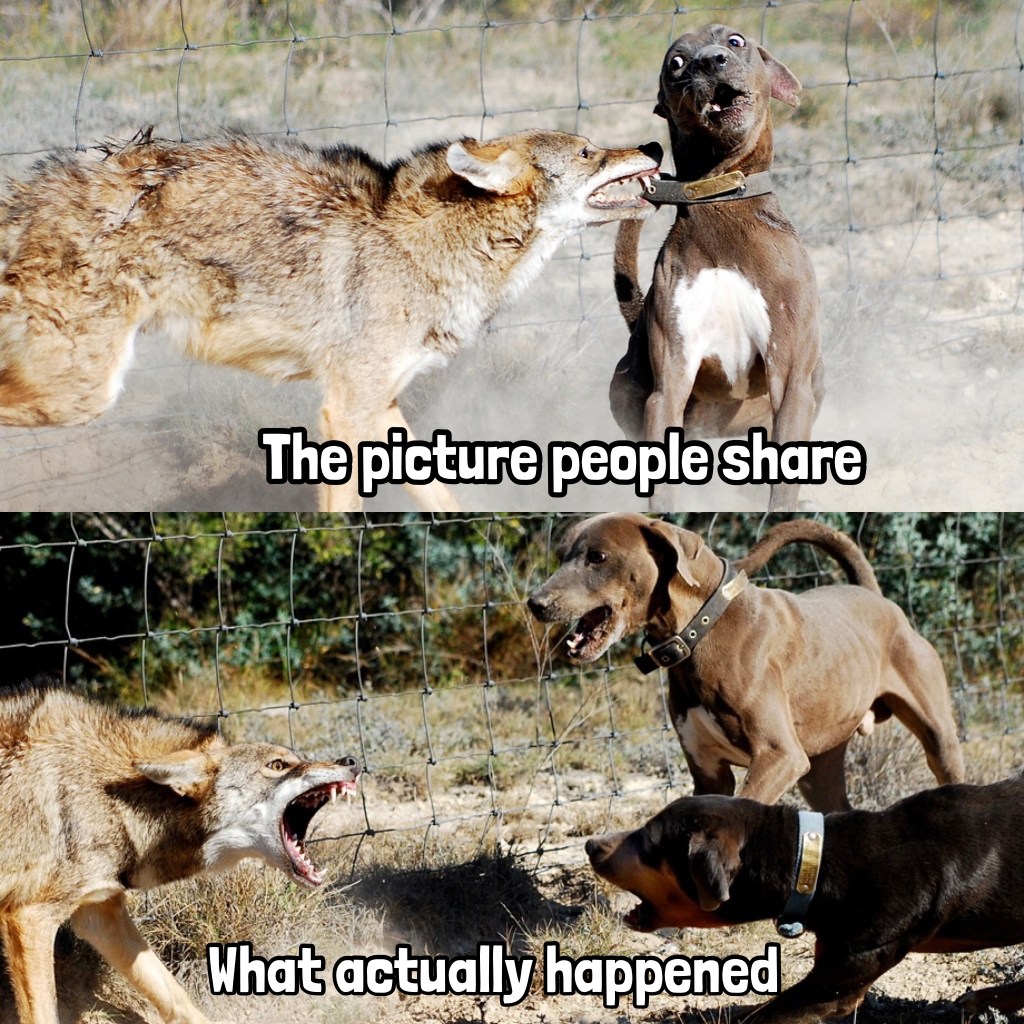
People love taking stories and photos out of context to vilify wildlife. We’re honestly not sure what the motive is, but it happens all the time. You’ve likely seen the top photo in warnings on social media about how coyotes are dangerous, brutal hunters who love to kill domestic dogs. Sometimes the photo includes an entirely fabricated story about how the coyote lured the dog to her and then attacked him. It always presents the coyote as the villain and the dog as an innocent victim.
We were able to track down the original video where the top image originated. The video clearly shows a coyote whose leg is stuck in a fence, either by a leghold trap or the fence itself. (The trapped leg isn’t shown up close.) The owner of the dogs unleashes all three dogs on the trapped coyote. They viciously attack her, three against one. The top image shows her desperately attempting to defend herself.
This is not a “mean” animal. This is a scared, hurt animal in life-threatening danger who is trying to protect herself against three animals who are larger and stronger than her.
Coyotes are not evil. They are sensitive, intelligent wild dogs who are dedicated to their mates and young and will, like any other mammal, defend themselves and their families. That includes defending themselves against domestic dogs when they’re attacked or in danger. This doesn’t make them bad.
Coyotes sometimes defend themselves against attacks by domestic dogs, and will occasionally prey on very small dogs left unattended. But most of the time, a coyote would greatly prefer to avoid dogs than to attack them or try to make meals of them.
Please don’t share the top photo without the additional context. Truth matters.
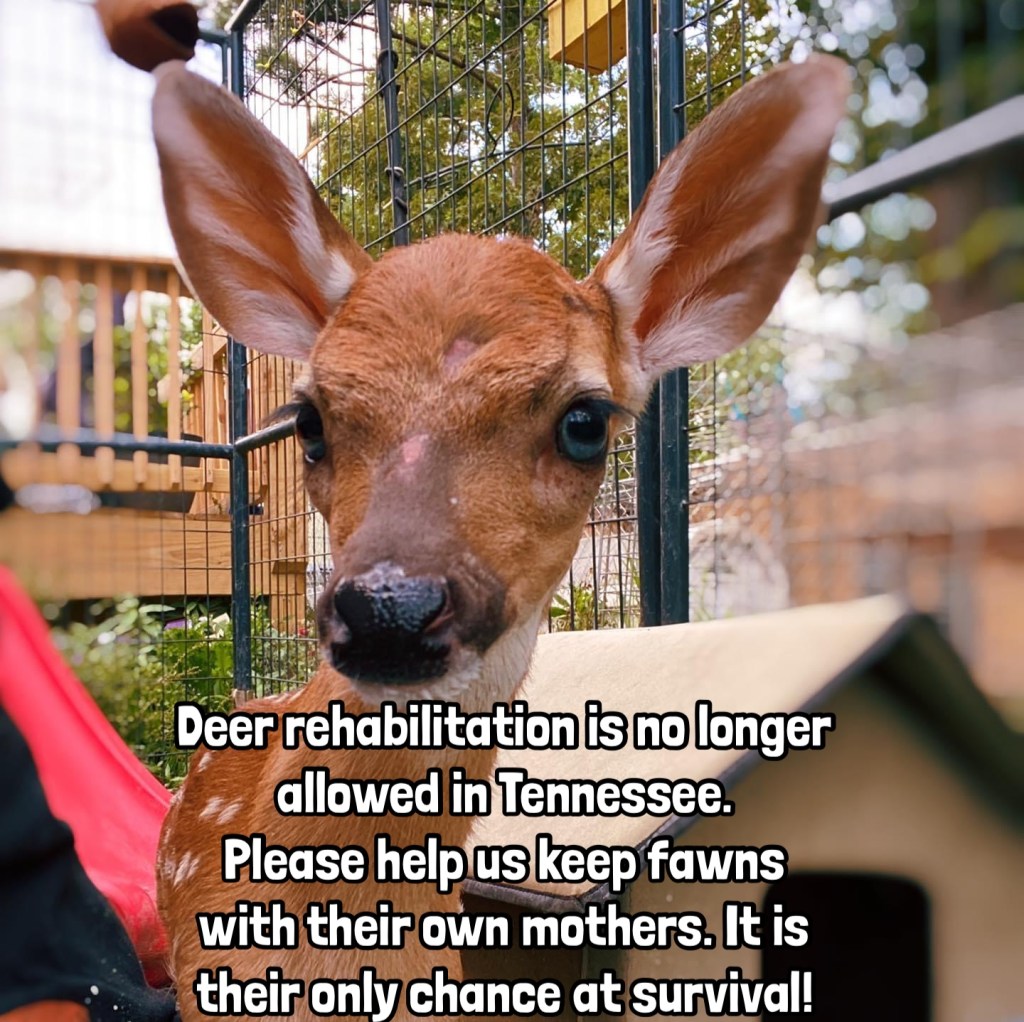
We’ve been dreading making this announcement, but with fawn season fast approaching and the new rules becoming official today, we’ve unfortunately got to break this upsetting news.
We (and other rehabilitators in Tennessee) will no longer be allowed to to rehabilitate deer under any circumstances. This is true regardless of the deer’s age, condition, or location within the state. We know this sucks, but our state officials made these decisions with careful consideration for the animals’ welfare and the prevention of disease.
Ultimately, the main reason for this rule is that we’ve been seeing skyrocketing rates of chronic wasting disease, or CWD, which first entered the Western side of the state and is slowly inching eastward. CWD is a very serious disease that causes immense suffering to the deer and could harm their populations or even begin infecting our wild elk and domestic livestock if it doesn’t become contained. Transporting fawns across counties— or worse, across entire regions of the state— may seem like the compassionate thing to do in the moment, but the reality is that it has been spreading disease, and not doing much to help the deer.
Another issue is that many rehabilitators in Tennesee and elsewhere haven’t been able to get them as wild as they need to be. Deer that have been hand-raised by humans will often walk right up to hunters, putting themselves in danger. They can even be dangerous to humans— deer that have lost their fear of people may attack us when in rut.
This doesn’t mean there’s no hope at all for deer in need. Nearly all adult deer are hardy and resilient and can survive very serious injuries without our help. Nearly all fawns who appear to be orphaned are actually just fine, and have a mother who is returning soon. It’s more important than ever to simply leave these animals alone.
Even when a fawn is a true orphan, all hope is not lost. Deer are incredibly loving mothers who will frequently adopt unrelated orphans. Many truly orphaned fawns will get adopted if they’re simply left alone. A few may not make it, but that’s not always such a terrible thing, either. Grim as it may be, many of our native predators depend on fawns as a food source and need them as prey, in order to raise their own families.
Please leave deer alone in Tennessee even if they are alone or appear to be in distress. Their only chance of survival, now, depends on us giving them space.
If we had a nickel for every time someone has called us because they bought a nest box and brought it home and realized there were already eggs in it, we’d have two nickels. Which isn’t a lot, but it’s weird that it happened twice.
If we’ve gotten two of these calls and we’re just one of hundreds of rehabilitation facilities in the country, this probably isn’t that uncommon of an occurrence. A lot of plant nurseries and home and garden stores sell nest boxes in outdoor areas, where cavity-nesting birds looking for a safe place to lay eggs might decide to use them.
If you’ve already taken a nest box home, things aren’t optimistic for the unhatched babies inside the eggs. Being tossed into a shopping bag and rolling around in a car can easily kill the young inside the eggs. And, while it’s a myth that bird parents will abandon their eggs or babies because of human smells, the parents may give up the search for their eggs by the time the nest box gets returned to the store and put back where it was found.
Please do this one tiny thing that may save a bird family. Before you buy a bird house, peek inside. If you see a nest being built, one or more eggs, or live baby birds, please leave it exactly where it is and pick a different nest box instead. Let a staff member at the store or nursery know that the box is occupied.
If you want to go the extra mile, gently remind the staff member that it is illegal to intentionally harm migratory birds or their eggs or active nests, and urge them to put a “do not disturb” sticky note and to leave the nest box exactly where it is. (The parents will almost definitely lose track of the nest if the box is moved, since nest cavities are never moved in a nature.)
And of course, if YOU work at a store or nursery that sells nest boxes, you can be the most helpful of all, by checking the bird houses that are for sale and protecting any that might end up occupied. People love supporting businesses that care about wildlife!




 For Fox Sake Wildlife Rescue