Although best known for his numerous other accomplishments, Booker T. Washington was one of the pioneers of the modern animal welfare movement. Mr. Washington formed a local chapter of the Bands of Mercy at Hampton University. The Bands of Mercy were conservationists and animal welfare advocates. Booker T. Washington and his Bands of Mercy colleagues called for an end to the over-hunting of wild animals, the protection of wild animals’ habitats, and the end of abuse of livestock and pets.
Fittingly, he is also the namesake of Chattanooga’s beautiful Booker T. Washington State Park, which partners with For Fox Sake in the protection and conservation of our local wildlife and natural resources. During Chattanooga’s deeply troubled past, Booker T. Washington State Park was established by a team of black conservationists as one of just two state parks in all of Tennessee that was accessible to our local African-American community. The park remains an important center for education, recreation, and conservation here in Chattanooga.
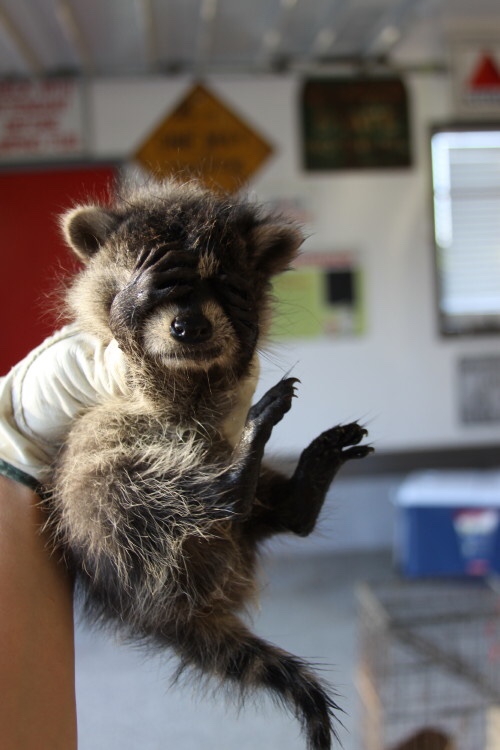
Raccoons usually cover their eyes when they’re scared and trying to hide. This may not seem like a particularly intelligent behavior, but it may be a sign that they’re among the smartest animals on Earth.
Small children often exhibit this same behavior, “hiding” by covering only their eyes . When scientists studied this tendency in human kids, they discovered that children do this because they believe the self, separately from the body, is visible through the eyes. Children with their eyes covered would acknowledge to researchers that their bodies, arms, hair, feet, and legs could be seen, but would insist, “but you can’t see me.”
This tells us that raccoons, like children, must also have a concept of selfhood, and a theory of mind. The only other animals to exhibit awareness of self are particularly intelligent, such as higher primates, some species of dolphin, and a few species of bird.
Some wildlife rescues choose not to share stories about animals that can’t be saved, because they don’t want to upset the public. While I respect that, I believe there’s bittersweet beauty in all we do, even in the cases that end in death.
The reality is that most of the calls I’ve received this year weren’t about cute baby animals that were rescued and released, but about animals terminally ill with distemper. This serious disease is only rarely treatable, and it can be difficult to distinguish from rabies, so most animals with distemper have to be euthanized.
It isn’t “saving” the animals in the way we want, but it’s still saving. It’s saving them from suffering, saving others from catching the infection, saving taxpayer funds by helping to track the rates of disease in wildlife and helping to submit the bodies for testing.
Grandpa here was suffering tonight, but he had a long life. He weighs about twenty-two pounds, much more than average. His fur is turning white and his teeth are worn. He must have once been a proud, powerful young boar who fathered countless litters of kits and claimed a wide territory as his kingdom. But even the most impressive animals’ lives come to an end, and grandpa’s end is tonight.
I’m not able to personally take Grandpa tonight for his last trip but was able to arrange to have him euthanized soon. He’ll be given a sedative and then an injection, the same as I would choose for a beloved pet. Then his body will be sent for testing to help track disease in Hamilton County.
Some would say this is a sad story, but I disagree. This is an animal who had a long life in the wild, who gets to have a comfortable, dignified end now that his time is over. That’s not a tragedy. It’s a triumph.
Whitetail deer are severely overpopulated in the United States, having increased from 300,000 deer in 1930 to 30 million deer today. This is bad news: deer overpopulation harms humans by contributing to auto accidents, harms forests by causing local ecosystem collapse, harms livestock when deer spread diseases that can wipe out an entire herd, and harms the deer themselves when these problems lead to starvation and epidemics. We simply can’t sustain the number of deer that currently exist in the United States. It isn’t healthy, and it isn’t natural.
Before humans extirpated apex predators from most parts of the continental U.S., they naturally kept the populations of game animals in check. It was a healthy part of the natural balance of our ecosystem. But today, apex predators like wolves have only been restored to a small fraction of their suitable native range. One major objection conservationists face comes from trophy hunters, who say they should have a right to kill wolves for sport, and will often justify this with feigned concern for the well-being of game animals.
Hunters can’t have it both ways. It’s impossible to justify mass-exterminating predators to protect deer, while also acknowledging the fact that whitetail deer are unnaturally overpopulated.
Hunters do sometimes play an important role in conservation. Hunting can sometimes be a more ethical source of meat than mainstream farming techniques, and in areas where deer are overpopulated, hunters can help prevent the problems they cause. But more hunters need to recognize that predators are an important part of appropriate wildlife management. If a hunter cares about addressing deer overpopulation, he or she should also care about protecting wolves.
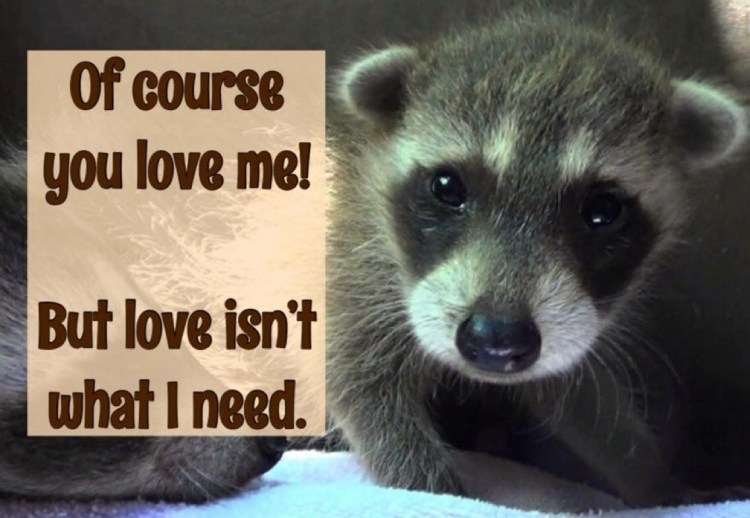
Good people, with good intentions, sentence animals to death every day with improper care. It’s terrible not just because the animals suffer, but because their well-meaning caregivers suffer, too.
Rehabilitating wildlife properly takes more than just love and dedication, and more than you can learn from a weekend crash-course on Google. To actually thrive on the wild, an animal needs large pre-release enclosures and survival training. It needs to imprint on other animals of its own kind, to learn what it is. It needs a healthy amount of fear— or at least indifference— toward humans. It needs to know how to forage for wild foods. It needs proper veterinary care. These things don’t become possible simply because you have the will and the passion to save the animal yourself.
With improper care, many wild animals become irreversibly tame and dependent, or develop painful bone deformities or blindness from malnutrition. Some will be content as pets until puberty, and will then become destructive and aggressive toward their handlers. Some will even spread serious diseases like raccoon roundworm and even rabies to their owners (or their owners’ pets).
If you have a passion for rescuing wildlife, please look into volunteering with a wildlife rehabilitation facility in your area. This is the first step toward getting the training and education you’ll need to care for orphaned and injured animals, and it ensures that more experienced people with proper facilities can oversee your work until you’re prepared to do it alone.
It’s great if you find a wild animal you want to help. Please don’t let your desire to help cause more harm than good.
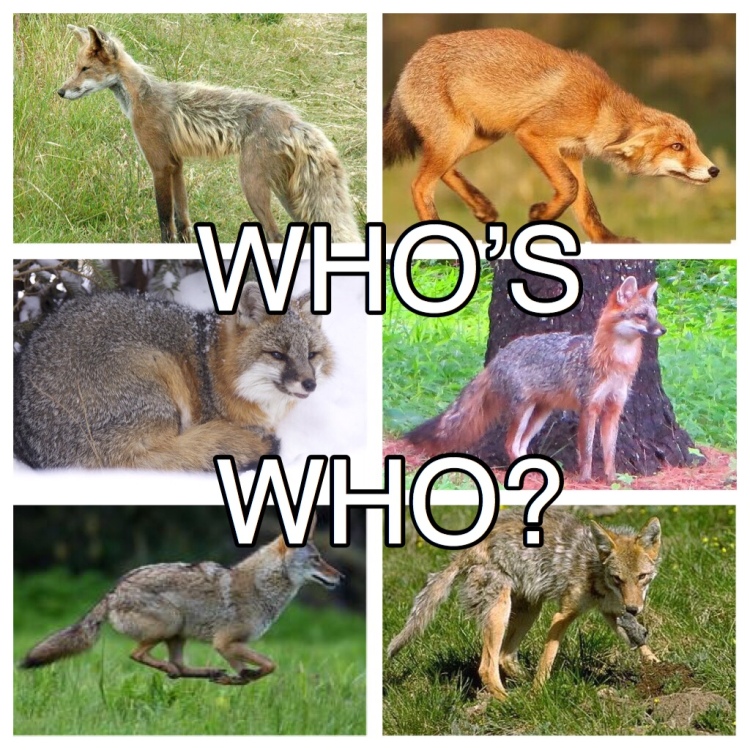
Quick: if you saw all six of these animals scurry across your yard, would you know what each of them is?
If the answer is “no,” that’s nothing to be embarrassed about and doesn’t mean you’re uneducated. Believe it or not, the majority of people can’t tell these critters apart easily, particularly when the animal is very young, underweight, shedding, or has mange.
Misidentification of wild dogs can lead to problems and misconceptions. Every time For Fox Sake shares the information that an average red fox in Tennessee is 8-12 pounds– about the same size as most house cats– the statement is met with shock, disbelief, and even aggression. Nearly everyone swears they have seen foxes the size of German shepherds, and many will even share photos of coyotes as proof.
Misidentification has also led to some confusion when Good Samaritans call saying they have a “fox” that needs rescuing… when the fox turns out to be a coyote.
Here’s a quick overview that can help you correctly identify your backyard residents.
The Red Fox, Vulpes vulpes
Red foxes have long, white-tipped tails and usually have orange-red fur.
This is probably the first image that comes to mind when you hear the word “fox.” The red fox is the most widely distributed member of the dog family in the world. Typically, red foxes weigh 8-12 pounds and are very tall and slim, with tails nearly as long as their bodies. Red foxes are built like mini greyhounds, but often have very thick fur, so they look bulkier than their actual size.
In general, red foxes have red fur with white markings under the chest, a white tip of the tail, black markings behind the ear tips, and black to dark brown “stockings.” However, red foxes have highly variable markings, so it’s often easiest to identify them by their build.
The Grey Fox, Urocyon cinsreoargenteus
Grey foxes have long tails with black tips.
Many people don’t even realize that this common, but elusive, animal lives in Tennessee! Grey foxes are the oldest surviving member of the dog family. The grey fox’s most distinct trait is its ability to climb trees, much like a cat. Their camouflage and tree-climbing abilities are among the reasons people rarely see them. If you see a small wild dog hanging out in a tree, there’s no doubt it’s a grey fox.
Grey foxes are built similarly to red foxes, but are often a little shorter and more muscular and weigh 8-10 pounds on average. Like red foxes, grey foxes have very long tails, nearly the same length as their bodies. A grey fox generally has grey fur on its back, tail, and face, with red-orange accents and white markings on the chest and belly, and a black stripe running down the spine. The backs of a grey fox’s ear tips are generally orange, and the tip of its tail is almost always black.
The Coyote, Canis latrans
Coyotes are much larger than foxes and have shorter tails.
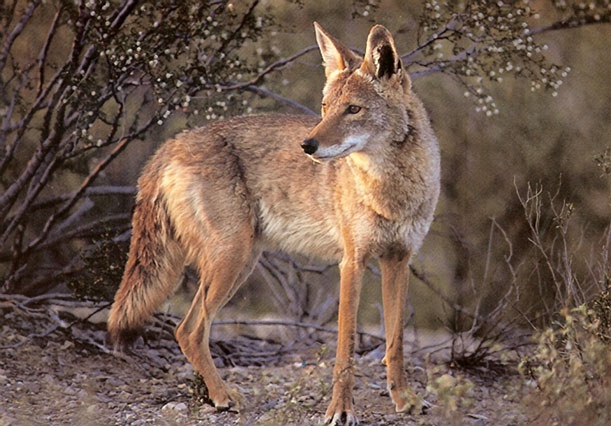
Here in Tennessee– and elsewhere east is the Mississippi River— coyotes carry a significant amount of ancestry from wolves and domestic dogs. As a result, coyotes in Tennessee can have a wide variety of colors and patterns, often look distinctly wolf-like, and typically weigh 30-50 pounds.
Aside from these clear differences in size, coyotes generally have much shorter tails than foxes in proportion to their bodies. The tip of a coyote’s tail is usually black, but coyotes don’t generally have significant black markings elsewhere.
So who’s who in the six-critter image above? The top two are red foxes, middle two are grey foxes, and bottom two are coyotes.
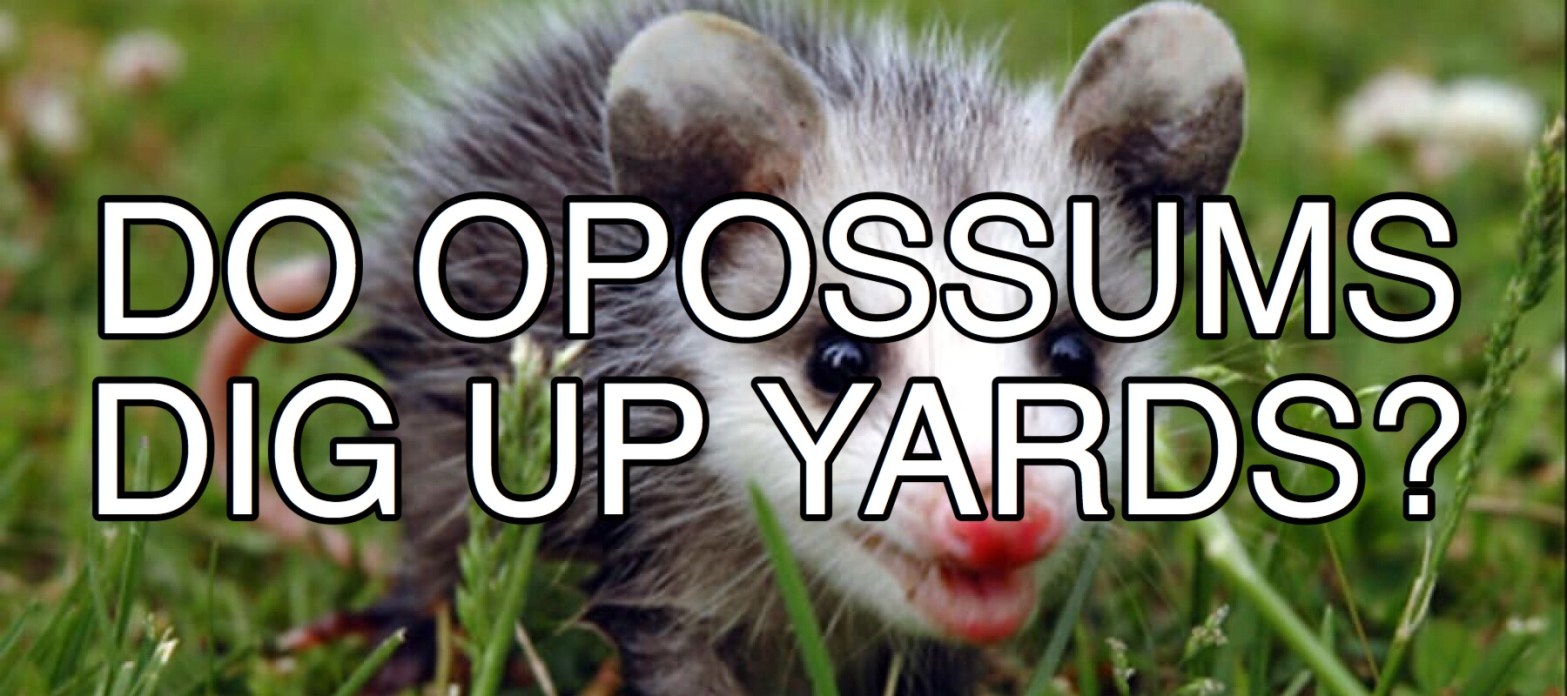
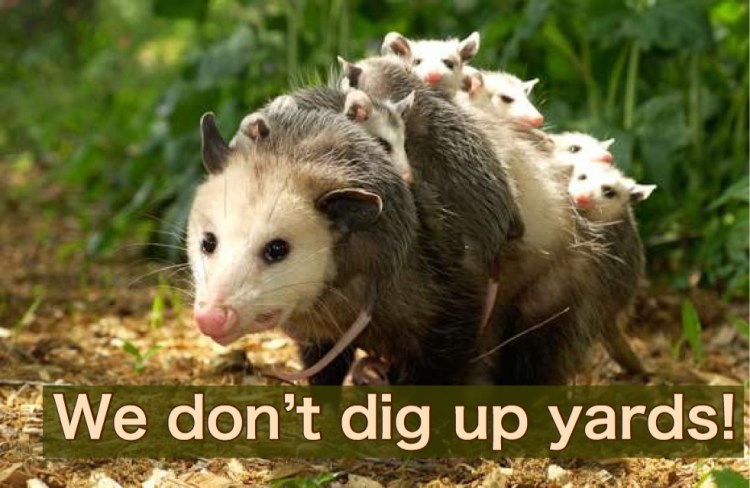
People are often quick to exterminate opossums because of the belief that they will destroy a lawn with digging or burrowing. While you may have some lawn damage, and may have opossums on your property, there’s no connection between the two.
Opossums are not digging, burrowing animals. In fact, they don’t spend a lot of time on the ground at all! Opossums are mostly arboreal (tree-dwelling) creatures and tend to stick to tree tops for safety. An opossum’s nails are made for climbing, and not nearly strong enough to withstand digging up lawns.
You might have seen an opossum appearing to dig in your yard (or someone else’s) at some point, but this isn’t what it looks like. Opossums will do a little bit of superficial foraging in grassy areas to look for things like bugs and snake eggs, but they do not root deep enough into the soil to actually create damage.
So who’s to blame for those holes in your yard? Depending on their size, shape, and location, they could have been dug by foxes, groundhogs, skunks, chipmunks, raccoons, or even a neighbor’s dog. Often, the best way to deter a digging animal is to use things like noise, motion-activated lights, bitter and spicy repellents, and scat mats. Trapping an opossum, the wrong animal, isn’t the answer and won’t help.
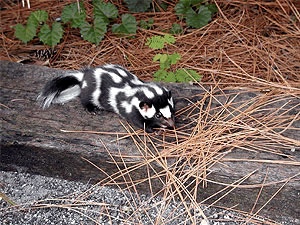
The Eastern spotted skunk, native to our region, has lost up to 99% of its population in the last seventy years. It is likely completely extinct through most of its natural range— including the region of Tennessee where For Fox Sake operates— and it could be completely extinct in the wild within a decade. And here’s the kicker: this animal still isn’t federally protected as an endangered species, and in Tennessee, there is no limit on the number that can be trapped or hunted.
Although this small, weasel-like skunk is adorable and plays a vital role in the ecosystem, it has fallen victim to stigma and misunderstanding. People tend to focus conservation goals on large, charismatic animals like giant pandas and African elephants. A small, stinky critter just doesn’t get the same amount of attention. For that reason, very little is known about just how few Eastern spotted skunks still exist and what might be done to protect them. The extremely limited research is the main reason that they still lack any protection as an endangered species. Without funding to track and monitor them, there is no proof of their imminent extinction. Without proof, the state and federal government simply won’t protect them.
For Fox Sake is one of just a few rehabilitation facilities licensed to accept Eastern spotted skunks, but I haven’t personally seen one in the wild since I was a teenager in 2004. Other Tennessee skunk rehabbers say they have never seen them— in some cases, never even heard of them— and TWRA officials told me they are likely extirpated from this area. If you are fortunate enough to spot one of these in the Southeast, please let your state and local wildlife authorities know. With enough dedication and attention from the public, we may be able to protect these animals and bring them back from the brink.
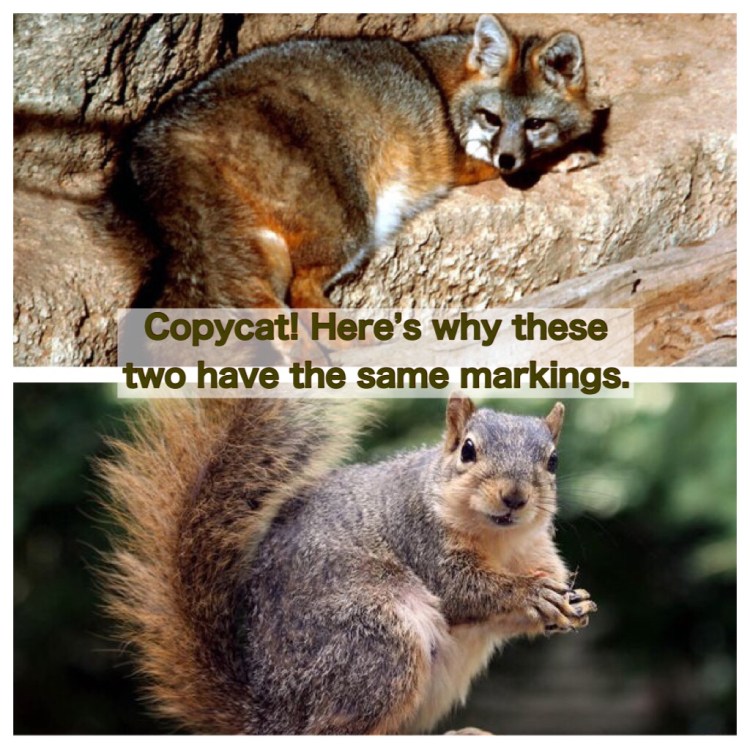
How did such different animals end up wearing the same outfit?
These two native species, the Eastern grey fox and the Eastern fox squirrel, have nearly identical markings. Both developed these patterns to adapt to the same environmental pressures. The light or white markings on their undersides, called countershading, help both animals camouflage when seen from the side, while he pattern of grey and red helps the animals blend in while climbing through trees.
The image of an opossum, dangling from a tree branch by its tail, is ubiquitous— but it’s not something you’ll ever actually see in the wild. Although opossums do have prehensile tails that they can use to balance and, sometimes, to carry things, they can only support their own weight by their tails as young joeys. Even in their youth, opossums don’t spend much time upside-down, and never fall asleep dangling by their tails.







 For Fox Sake Wildlife Rescue