Don’t Relocate Skunks!

Well-meaning home owners often relocate skunks because they’re bothered by occasional whiffs of musk. It may seem like relocating an animal is a humane form of pest control, but it’s unfortunately not. Every year, thousands of mother skunks are taken away from their babies, who are left to die brutal, painful deaths by starvation. Skunks are extremely sensitive animals and doting mothers, so this separation is also very traumatic for the adult.

The mama skunk isn’t likely to make it, either. A skunk relocated to unfamiliar territory, particularly during breeding season, is likely to die of exposure or starvation, or to be killed by rivals. She may also spread or catch diseases, some as serious as rabies, without showing any obvious symptoms.

Because of this, many states including Tennessee have laws prohibiting the capture and release of skunks anywhere besides the property where they were found. Please see the coexisting section of our website for tips on humanely repelling nuisance wildlife.

Tennessee’s Slender Glass Snake

Only a lucky few will see one of these rare creatures within our beautiful state— and most will mistake them for snakes! Slender glass lizards are endangered within the state of Tennessee due to human disturbance of their habitat and the introduction of unnatural predators like outdoor cats. They usually live in open grasslands and dry forests and sometimes make their homes in the abandoned burrows of other species. Although slender glass lizards look a bit like snakes at first glance, they’re distinguished by the presence of ear holes, differences in behavior, and distinct vertical stripes.

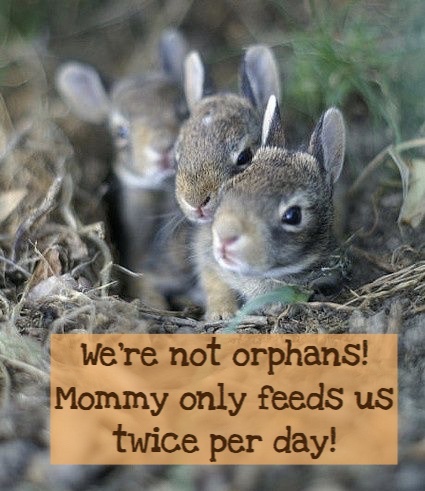
Cottontail Mothers Feed Young Twice Daily

Cottontails don’t generally nest in burrows or dens, but in shallow depressions right in the middle of a forest of lawn. Predators are everywhere, but these babies stay safe while hidden in plain sight! That’s because mother cottontails have an impressive technique for keeping their babies hidden. Unlike other mammals that lie with their young as much as possible, a mother cottontail will simply stand over her nest to nurse her young twice per day— once at dawn and once at dusk— and will scamper away. The babies, which have no scent of their own, are so still, quiet, and small that they usually aren’t discovered by predators until they’re old enough to leave the nest. An absentee mom isn’t a sign that baby cottontails have been orphaned, but that she is doing a good job keeping them hidden.

All wild animals have the best possible chance of survival if they’re raised in the wild by their own mothers. Please don’t kidnap healthy baby bunnies! Mom is taking care of them and will be home at dusk.

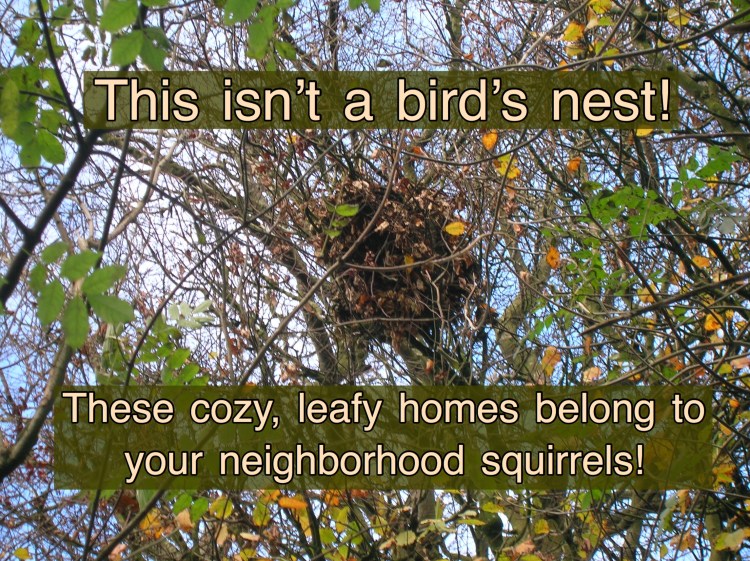
Dreys: Those Leafy Squirrel Nests

Have you spotted these nests in your neighborhood? These are called dreys. Tree squirrels and flying squirrels build them out of leaves, grass, bark, and twigs in the forked branches of trees, when cavity nests aren’t available. A pair of male and female squirrels will often share a drey until the female becomes pregnant, but Dad later leaves to give room to the new babies.

Dreys are much more common today than they were hundreds of years ago. Squirrels— particularly flying squirrels— prefer to nest in the hollow cavities of old trees. These cavity nests keep them much safer from predators, and much warmer in chilly weather. But, since old-growth forests are now rare, squirrels have been forced to adapt to nesting in dreys, where they are 40% more likely to die as babies.

It’s easiest to spot dreys this time of year, when trees are still bare. Do you have dreys in your neighborhood right now?

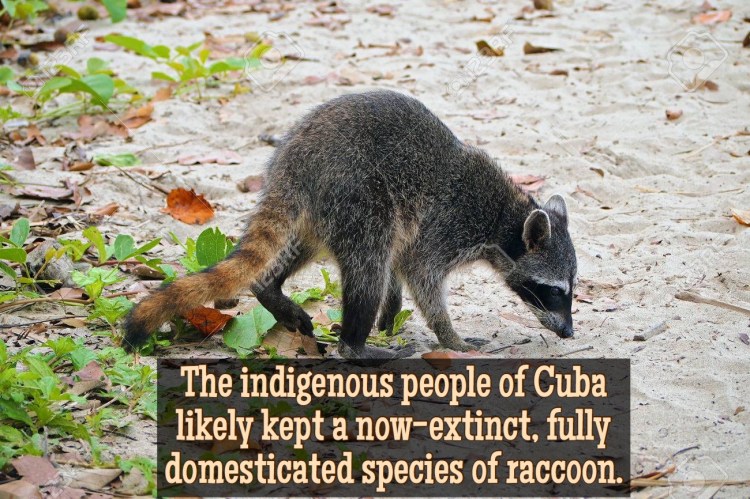
The Domesticated Raccoons of Cuba

Early invaders from Spain described a strange animal, farmed and raised by the Taíno people of Cuba. These “mute dogs,” as they were described, were friendly creatures that were small, agile, and extremely intelligent, but didn’t look like normal dogs and didn’t bark or howl. The indigenous people of Cuba raised them as pets and working animals, and also used them for their meat and fur. Many naturalists and historians believe that these “dogs” were not dogs, but a domesticated species, or subspecies, of raccoon.

Cuba’s native raccoons, both domestic and wild, are now completely extinct. Wild raccoons in Cuba were hunted to extinction for their meat by Europeans, and the “mute dogs” became extinct after disease and genocide destroyed the people who raised them. The animal pictured here is a related Caribbean raccoon.

Tennessee’s Snowshoe Hares

Yesterday, Chattanooga— where For Fox Sake is based— did the most stereotypically Southern thing possible. In anticipation of less than half an inch of snow, we cleared out all the milk sandwich ingedients from our local grocery stores, closed schools and businesses, and huddled into our homes expecting the worst. The few flurries that fell were all melted by 9:00 a.m.

It’s hard to believe that snowshoe hares, well-known as an arctic species, once made their homes right here in this warm Southern state. But they did— possibly even in your lifetime!

Some of the high-altitude mountains in East Tennessee were once rich in mature, coniferous forests where snowshoe hares can thrive. Although they were never especially common here, snowshoe hares were recorded sporadically in Tennessee mountains into the 1970s.

It’s extremely unlikely that snowshoe hares still live in Tennessee. Human development has nearly destroyed the mature mountain forests that arctic hares depended on for their survival, and climate change has eliminated the expected winter snow-cover that kept snowshoe hares safe in their white winter coats. Today, climate change is threatening even Canada’s snowshoe hares as they struggle to adapt to a warming planet.

Still, there’s a small chance that an isolated population of arctic hares still make their home somewhere in the state, in some secluded forest left pristine from human development. It’s just one more reason to protect the natural treasures of our beautiful state.

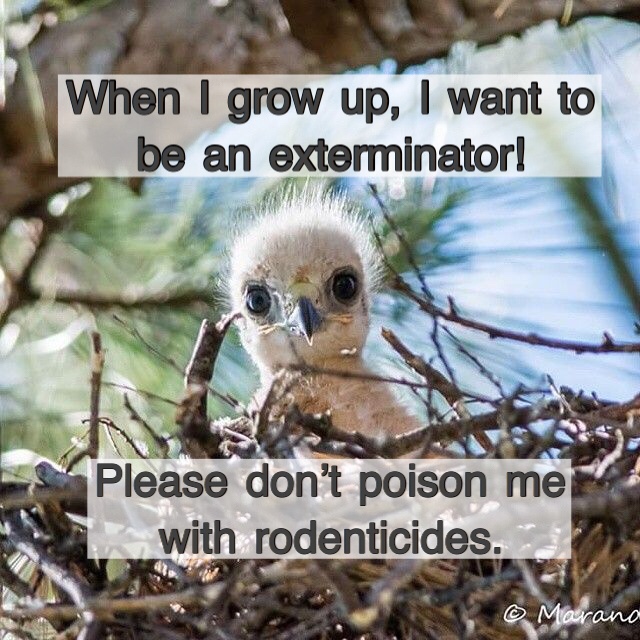
Hawks are Exterminators: Don’t Poison Their Food!

Native hawks are part of nature’s most powerful pest control crew! A single red-tail hawk can eat dozens of rats, mice, and other potential pests in a single week. This benefits humans by reducing the spread of disease and keeping crops and homes safe from damage.

Like most predators, hawks will often target prey that is slow, sick, and easy to catch… such as, for example, a rodent that has been poisoned. When hawks ingest poisoned rats and mice, they can eventually succumb to poisoning themselves.

This epidemic is catastrophic for predators and their families, and it’s not good for us, either. When a family of hawks (or other rodent-eating predators) dies of secondary poisoning, it causes a local explosion in rats and mice, creating a treadmill of repeated poison use that can also eventually impact foxes, snakes, skunks, raccoons, cats, and dogs.

There are many humane pest control methods to eliminate rodents without poison. Trap-and-release, scent and taste repellents, proper home hygiene, and exclusion are ideal. If you must use poison, consider using a formula designed to minimize the risk of harm to predators.

How Big Are Coyotes? Smaller Than You Think!

Many people who have seen coyotes estimate that they’re at least the size of German shepherds, but coyotes are actually pretty small, weak animals. Out West, a typical coyote weighs a puny 16-18 pounds. Here in Tennessee, where they owe much of their ancestry to red wolves and feral dogs, coyotes are larger, but still tend to be in the same size range as a medium-small dog breed like a cocker spaniel or a corgi, with the largest males maxing out at the size of a typical border collie.

You certainly wouldn’t want to try to fight off a coyote, and it is extremely unwise to leave children and small pets unattended at dawn and dusk. But most humans have absolutely nothing to fear from the shy, nervous, relatively small coyote. In all of American history, coyotes have only been known to kill two people. You’re much, much more likely to get killed by a stray dog, a bee sting, or even a feral cat than by a coyote.

So why do we collectively imagine coyotes as enormous and dangerous? It’s likely a quirk of human psychology in response to fear. Any defective knows that a frightened witness will tend to over-estimate a criminal’s height by several inches, in reflection of her sense of intimidation. A child will often claim to have seen a spider the size of a fist, in areas where no such spiders exist. And there’s also the simple fact that coyotes are built very lean and light, with fine bones but thick fur, so they appear bigger than they are.

Use common sense around all wildlife— don’t assume that any wild animal is “safe” to handle, approach, or provoke. But the coyote in your neighborhood isn’t likely to eye you as its next meal and wouldn’t likely have the strength to do so.

Firefighters Rescue “Puppies” That Are Actually Foxes

Animal mix-ups are a strange– and sometimes hilarious– part of wildlife rehabilitation. Here in Chattanooga, we’ve had calls about foxes that turned out to be coyotes, squirrels that were actually raccoons, and my personal favorite: a hawk that couldn’t fly, which was actually somebody’s pet chicken.

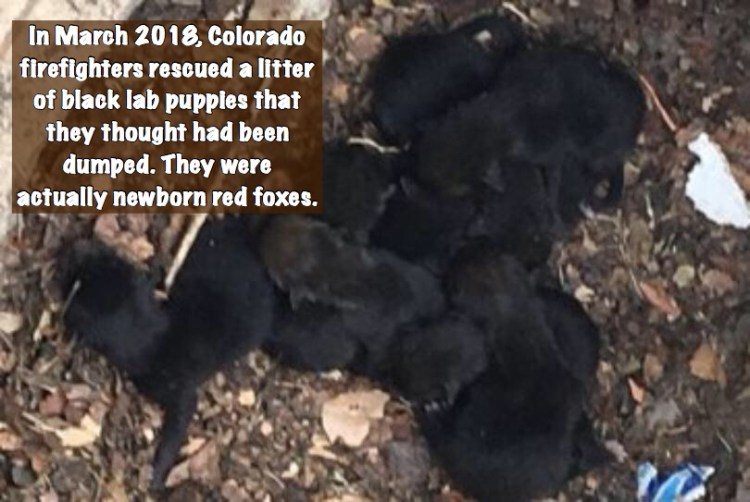
Colorado Springs rehabilitators got to deal with a similar mix-up when firefighters responded to a call about a litter of tiny black lab puppies that had been abandoned in a storm drain. The firefighters gently captured the “puppies” and brought them to the humane society, where they were informed that the puppies were actually red foxes.

It’s common for red foxes to be black or dark brown at birth, so it isn’t unusual that these kids looked like puppies to people unfamiliar with wildlife. But it’s also possible that the kits stayed black.

Despite their name, red foxes can be many colors, including melanistic. Melanistic red foxes are black in color with a beautiful silver overcoat. Because of the silver overcoat, they are often referred to as “silver foxes,” but they are the same species as ordinary red foxes.

Unfortunately, only half of the kits– five out of ten– survived their first week of life in captivity. Captured wild animals often succumb to a tragic and complex condition known as , caused by the stress of being taken into captivity. This highlights the importance of never capturing wildlife except in emergencies.

The survivors were, fortunately, cared for by permitted rehabilitators and successfully released to the wild.

Disturbing Video Shows Children Feeding Bucks

This is a still from a viral video that has been making the rounds on social media today. The video shows children in a suburban neighborhood feeding bread to adult bucks. Although people shared the video saying that it was beautiful and inspiring— and although the children certainly look happy— this is disturbing for a number of reasons.

Deer should be fearful of humans. This is important for their safety and for hours. Fearlessness of humans will lead deer into heavily populated areas, where they run the very real risk of being hit by cars, which is a frequent cause of death for both the deer and the motorist. Deer who are fearless around humans are also very easy targets for hunters.

The risk for the children is also serious. No parent in their right mind would send children into the street to feed coyotes, and an adult buck is at least as dangerous. Bucks are naturally territorial animals and are equipped with hard, sharp, powerful weapons. A healthy adult deer is also many times the size of these small children. If the animal got spooked, or simply wanted more food than he was offered, these children would be hospitalized or even killed by their injuries.

Deer are beautiful animals, but they need to be respected from a distance. If you see deer in your neighborhood, please watch from the window or porch. Don’t approach them, and certainly do not feed them.