Don’t Befriend Raccoons

It’s not uncommon for people to attempt to befriend wildlife. They start by leaving food on their steps, then offering food by hand, then eventually petting and even holding the animal. It sounds like a magical experience, but this temporarily rewarding moment can be a death sentence for the animal.

Raccoons in particular are at risk from people trying to befriend and tame them. As one of the more common carriers for rabies, raccoons are quickly euthanized when they appear to show unusual or fearless behavior. A raccoon who has been tamed by one person will quickly start approaching, following, or even aggressively harassing strangers, who understandably mistake this behavior for symptoms of illness.

Befriending a wild animal also isn’t good for you or your family. Wild animals can carry many diseases that are transmissible to humans and pets. Foxes carry feline and canine distemper and parvoviruses, while raccoons carry all of those plus a fatal form of roundworm. It isn’t worth the risk of exposing yourself or your pets to these risks.

If you’re interested in befriending wildlife, look into volunteering with your local nature center, zoo, or rehabilitators. Many have non-releasable wild animals in their care who you can meet.

How Do I Get Raccoons to Leave My Attic?

For the next few months, raccoons all over the country will be desperately looking for places to have their young. If there’s an opening that allows a mother-to-be into an attic, she will understandably think that this warm, dry shelter is a perfect place to raise her new babies.

But what happens when the homeowner finds her and calls a pest control company? In some states, the mother and kits might be moved to a protected area, but in others— including Tennessee— wildlife removal companies are required to euthanize any raccoon trapped as a “nuisance.” The ”lucky” ones are gassed to death, while the rest die of overheating and dehydration in hot trucks.

There is a better way. Before baby season arrives, please make sure your attics and crawlspaces can’t be accessed by wildlife. If a mother somehow makes her home in your attic despite your best efforts, you can scare her away using a combination of bright lights, loud noises, and strong smells— such as a radio, a rag soaked in ammonia, and a strobe light. It may take her a few days to leave, but she and the kits will eventually be on their way.

The Grey Fox: The Cattiest Dog

The grey fox, one of the native species that For Fox Sake rehabilitates, is one of those peculiar animals that massively fails the “duck test.” In many ways, this shy, reclusive animal seems exactly like a wild cat. It is small, nocturnal, solitary, and agile, and has retractable claws that it uses to climb trees, where it spends most of its time.

But, despite appearances, grey foxes are actually canids— dogs. They are actually the oldest surviving member of the dog family and have remained virtually unchanged for millennia.

Tennessee’s Endangered Flying Squirrel

This cutie pie is a rare sight, spotted occasionally in some of the higher altitude areas here in East Tennessee. Carolina flying squirrels are a subspecies of the Northern flying squirrel, currently facing the possibility of extinction due to habitat fragmentation and pollution. Its greatest threats come from the loss of the old-growth spruce forests where it prefers to build its nests.

Tennessee’s Red Squirrels

American red squirrels aren’t endangered, but here in our home state of Tennessee, they’re not very common. Red squirrels in Tennessee tend to stick to the high-altitude forests in Eastern Tennessee near the North Carolina border. They’re distinguished from their more widespread grey cousins by their smaller size, reddish fur, and less bushy tail. In summer, they often have a black stripe on each side, and in winter, their ears grow tufts!

Can the Porcupine Return to Tennessee?

Many Tennesseans don’t know that this cutie pie, the American porcupine, once lived in our state. The American porcupine was once abundant in the mountains of East Tennessee, but they were completely eliminated from our state by people who regarded them as pests, mostly because of their tendency to seek out salt-treated woods that were historically used in log cabin construction.

Tennessee has a long, proud history of saving and reintroducing animals that were previously eliminated, or had become endangered, through the State Wildlife Action Plan. Although there are no immediate plans to reintroduce the American porcupine to its former range in Tennessee, our state might be home to porcupines again some day in the future.

On Following the Law, Even When it Hurts

I dedicate my life to caring for Tennessee’s native wildlife, and specialize in foxes, skunks, and raccoons, but unfortunately, there are hard limits on which animals I am allowed to save. In Tennessee, a fox, skunk, or raccoon can not be accepted for rehabilitation if it is over six months of age. This is because adult animals are slightly more likely to be infected with rabies.

I do respond to calls about sick and injured adults, but when that happens, the plan is not to rehabilitate them, but to euthanize them to end their suffering, or to test an animal for rabies when it has bitten someone. It is one of the hardest parts of the job but it is something I do out of a deep desire to prevent the animal from suffering, and to prevent the spread of serious diseases.

Unfortunately, some finders who call to check on these animals have a hard time understanding my obligation to follow the law. I have been yelled at, cursed, and even threatened when I’ve explained that I took a sick or injured adult animal for euthanasia. This makes an already painful experience so much harder. I do not euthanize animals out of malice, but out of love and passion and dedication, even when it breaks my heart.

Please be kind if a rehabilitator tells you they will be euthanizing an animal. We have a hard, demanding, unpaid job, and euthanasia is one of the hardest parts of it. We have to follow the law, even in cases when the law may seem unfair or even when you believe that an animal’s condition may be treatable.

Grey Fox or Coyote Pup?

Grey foxes are sometimes killed because of a case of mistaken identity. This shy and elusive animal may look similar to a coyote pup at first glance, but can be distinguished by its very long tail with a black tip, its orange ears, and a black stripe that runs down most of its body. They never grow much larger than a cat, so they pose absolutely no threat to pets or humans.

(Plus, it’s really not a good idea to kill baby coyotes anyway.)

Tennessee’s Southern Bog Lemming

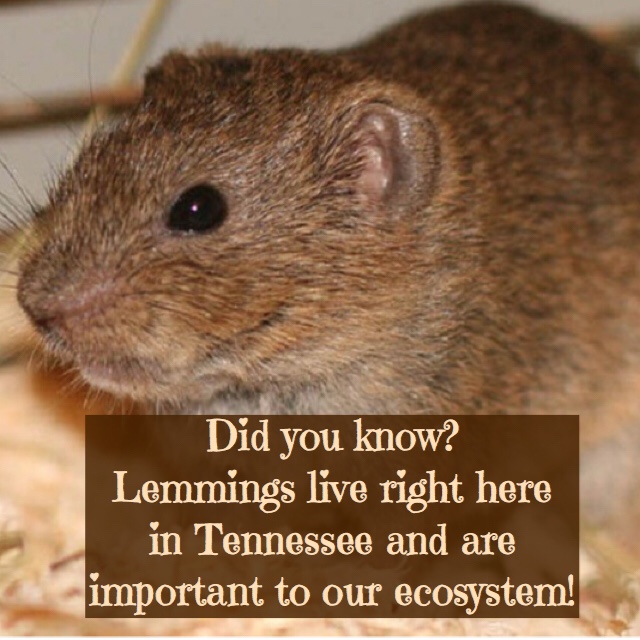
Many people think of lemmings as exotic animals that live only in cold wilderness areas. But this little fellow right here, the Southern bog lemming, actually lives right here in the Southern U.S.! Southern bog lemmings are a vital part of our ecosystem, as the preferred prey of many threatened and endangered native animals. Although the big lemming was historically found state-wide, it is now becoming uncommon except in a few mountainous regions here along the eastern border. The main threats facing bog lemmings, right now, include the loss of wetlands, predation by house cats, climate change, and competition from invasive rodents. You can help protect Southern bog lemmings by supporting your local wildlife sanctuaries and keeping your cats indoors.

Fishers Return to Tennessee

This handsome member of the weasel family, called a fisher or fisher-cat, was driven to statewide extinction by over-trapping. In 2002, conservationists selected a remote, forested area in middle Tennessee to re-introduce this animal to its native habitat. No one knows how successful they have been. Tennessee’s fishers lived on a diet rich in snowshoe hare and American porcupine, both of which are now completely gone from the state, so they may have succumbed to starvation… or they may have adapted and thrived. If the reintroduced fishers and their descendants survived, they are probably in mature forests in Cumberland County. Have you spotted a fisher in Tennessee?